
Development of predictive models for the dynamics of amorphous systems by graph neural networks and generative models
Glass dynamics
Graph neural networks
Molecular dynamics simulations
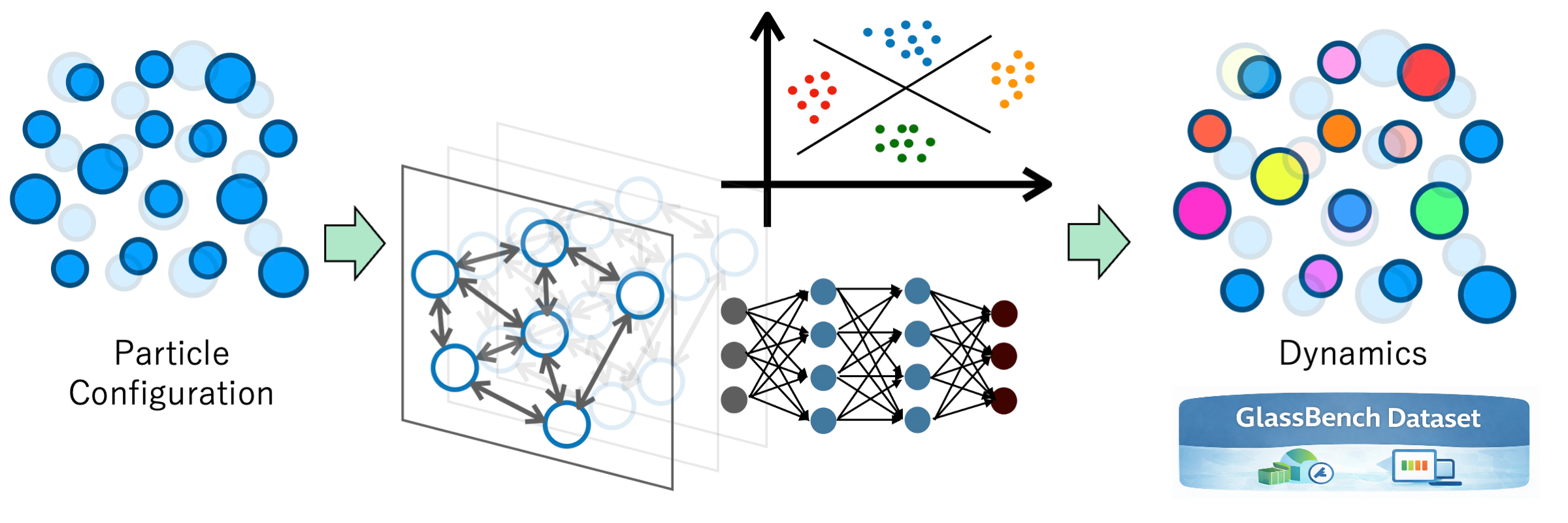
Abstract
- Glasses are materials that solidify while maintaining a disordered, amorphous structure. Machine learning methods have steadily improved our ability to infer and predict their dynamics.
- In this study, we achieved state-of-the-art predictive performance for glass dynamics using Graph Neural Networks. We also conducted international joint research with developers of other machine-learning models, using our dataset to compare predictive accuracy and physical properties.
Key Achievements
- Developed and released a Graph Neural Network (GNN) model that predicts particle mobility, i.e., expected particle displacements, in glasses. Its predictive capability was dramatically improved by modifying the message-passing mechanism so that the model learns multiple complementary dynamic quantities simultaneously.
- Constructed and publicly released a comprehensive dataset of molecular dynamics (MD) simulation trajectories to meet the large data requirements of GNN training.
- Conducted an international collaboration to benchmark emerging machine-learning models for the dynamics of glass formers. This collaboration resulted. in a Technical Review published in Nature Reviews Physics in January 2025 and the release of GlassBench, a curated evaluation dataset designed to support future benchmarking efforts