Development of the Self-learning Monte Carlo method with CPU and GPU
Abstract
This research developed a Self-Learning Monte Carlo (SLMC) method that simultaneously utilizes CPUs and GPUs on the University of Tokyo supercomputer Wisteria/BDEC-01 by enabling parallel CPU–GPU execution of Path-Integral Molecular Dynamics (PIMD), resulting in fast and efficient machine-learning interatomic potentials; furthermore, by introducing Transformer-based generative AI, the accuracy of effective models was significantly improved, allowing precise description of long-range correlations and leading to successful clarification of long-standing unexplained physical properties in real materials such as quasicrystals.
Key Achievements
We developed an efficient implementation of the Self-Learning Monte Carlo (SLMC) method optimized for supercomputers, together with novel models and algorithms, enabling highly efficient machine-learning models and resolving, in combination with experiments, a 20-year-long mystery of high-temperature specific heat in quasicrystals (Y. Nagai et al., Physical Review Letters 132, 196301 (2024)); this work was accompanied by a press release entitled “Unusual Physical Properties of Quasicrystals Induced by Six-Dimensional Fluctuations.”
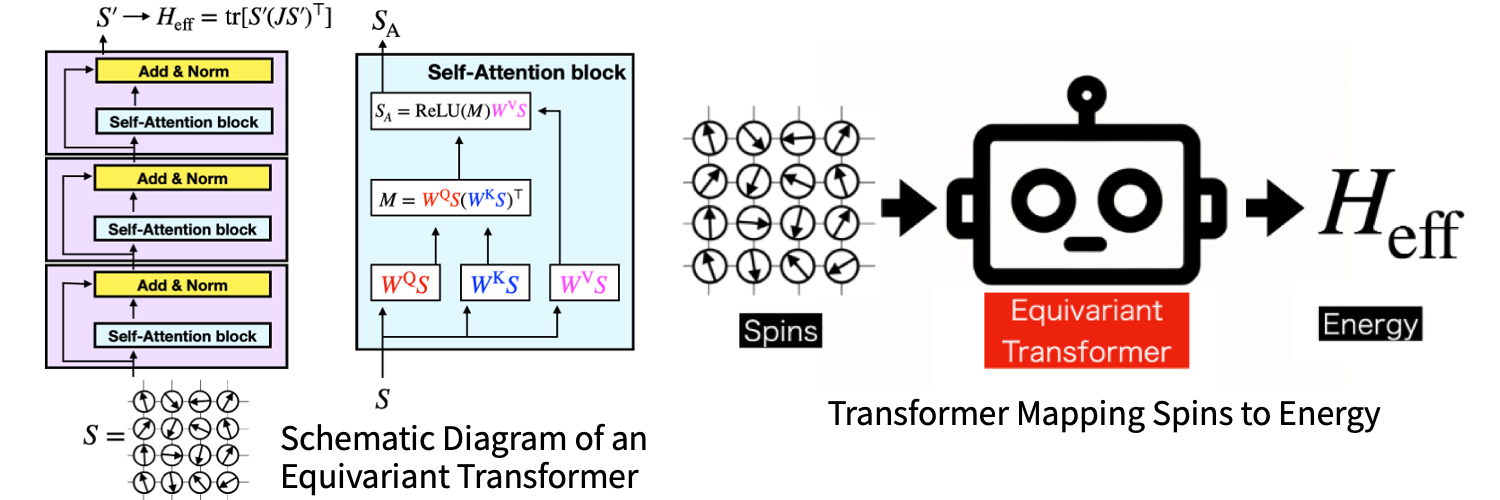
Separately, we developed a machine-learning model based on Transformer architecture, a core generative AI technology, and demonstrated its effectiveness for physical modeling (Journal of the Physical Society of Japan 93, 114007 (2024)), which was selected as an Editors’ Choice.