
Assessment of the Impact of Climate Change on Probable Maximum Precipitation: A Study of Linear Precipitation Bands
Abstract
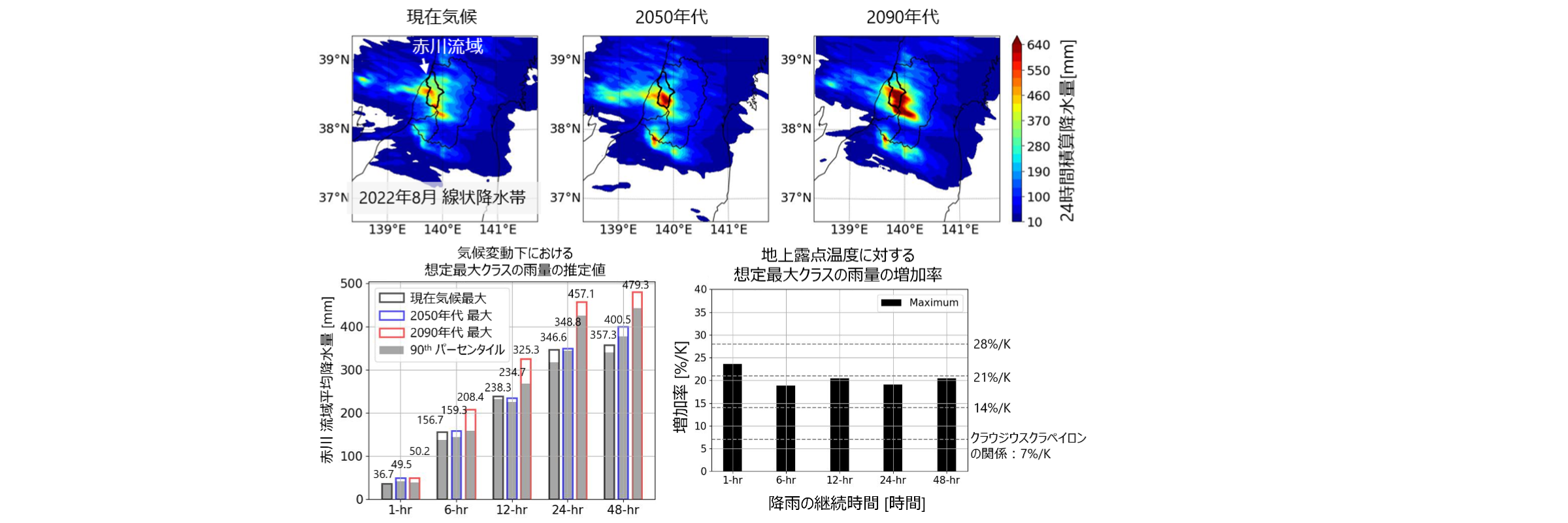
Although the magnitude and frequency of extreme precipitation have increased in recent years, the impacts of climate change on Probable Maximum Precipitation (L2) remain insufficiently understood. Assistant Professor Yusuke Hiraga (Tohoku University) and his research team developed a module that incorporates climate change effects into the numerical weather model WRF, implementing a dynamic model-based estimation methodology for Probable Maximum Precipitation on the supercomputer AOBA-S. By executing large-scale ensemble simulations that combine diverse climate change scenarios with the spatial shifting of rainbands, they achieved the world’s first quantification of the rate of change in L2 rainfall associated with linear precipitation systems. Their results revealed that the rate of increase in Probable Maximum Precipitation could reach up to three times the Clausius–Clapeyron relation. This work has provided highly significant insights both academically and socially, as reflected in multiple publications in top-tier academic journals and strong recognition toward societal implementation both domestically and internationally.
Key Achievements
- Developed a pseudo-global-warming module that automatically reflects climate change impacts in WRF, achieving accelerated execution through parallel processing on the supercomputer AOBA-S.
- Enabled the simulation of numerous extreme rainfall scenarios within realistic computational timeframes by massively parallelizing high-resolution WRF runs on the supercomputer AOBA-S.
- Performed a large-scale ensemble of 480 simulation cases—combining four global climate models, two emission scenarios, and spatial-shift perturbations—enabling Probable Maximum Precipitation (L2) evaluations that account for climate uncertainties.
- Quantified for the first time globally that the rate of increase in L2 rainfall can drastically exceed the ~7%/K rate dictated by the Clausius–Clapeyron relation, reaching up to 21%/K.
- Elucidated that dynamical drivers—such as enhanced low-level convergence and updraft intensification driven by latent heat release—are crucial factors in extreme rainfall amplification alongside moisture increases.
- Earned high academic acclaim with multiple publications in premier field journals, including the Journal of Hydrology and Journal of Hydrometeorology.
- Featured in major media outlets, including the Nihon Keizai Shimbun and Yahoo! News, attracting widespread domestic and international interest for practical application in climate-resilient disaster prevention and flood control planning.